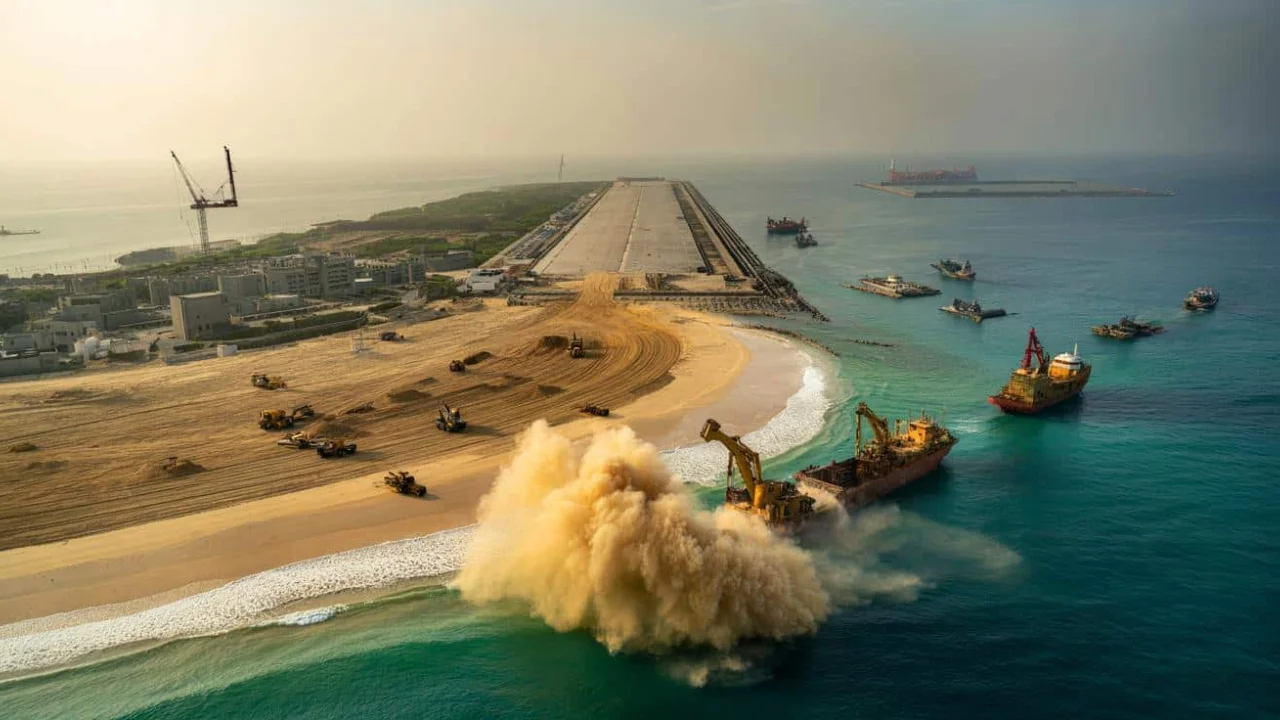
China Artificial Islands: The story of China Artificial Islands is one of the most dramatic transformations of ocean space we have seen in modern times. What used to be open water and scattered reefs in the South China Sea are now home to airstrips, military bases, roads, and concrete cities rising from the sea. The scale of this engineering project is almost unbelievable, and the speed at which it was done has left the world watching closely.
In just over a decade, China Artificial Islands have shifted power dynamics in the region, raising questions about territorial claims, environmental impact, and international law. This blog takes you through how these islands came to be, what they are used for, and why they matter not only to nearby countries but also to global trade, security, and the environment.
China Artificial Islands
At the heart of China’s move in the South China Sea lies a powerful blend of engineering and strategy. Building on top of reefs and shallow waters, the country has turned scattered underwater features into fully functioning islands. These structures are not just piles of sand. They now support runways long enough for fighter jets, ports deep enough for large vessels, and radar stations scanning the skies and seas.
China Artificial Islands serve multiple purposes. Officially, they are said to support civilian needs like weather forecasting and maritime rescue. But in reality, they also host hardened shelters, missile systems, and military-grade runways. These artificial landmasses extend China’s presence far from its coastline, helping enforce territorial claims and challenging the status quo in one of the busiest maritime zones in the world.

Overview of China Artificial Islands
| Aspect | Details |
| Purpose | Strengthen territorial claims, expand military and civil reach |
| Method | Dredging sand and rock to build on reefs and shallow waters |
| Region | Mainly in the Spratly Islands, South China Sea |
| Timeline | Major construction occurred from 2013 to 2016 |
| Total Land Created | Over 1,200 hectares of artificial land |
| Main Locations | Fiery Cross Reef, Mischief Reef, Subi Reef |
| Facilities Built | Runways, ports, radars, military shelters, helipads |
| Claimed Civil Uses | Maritime rescue, weather monitoring, navigation support |
| Environmental Impact | Coral reef damage, loss of marine biodiversity |
| Strategic Outcome | Increased surveillance and control over shipping lanes |
How China turned empty reefs into solid ground
What makes this story so striking is how quickly the landscape changed. On satellite images, what was once just a patch of shallow water became land almost overnight. The process used is known as land reclamation. Dredging ships pull sand and sediment from the ocean floor and pump it onto coral reefs. Bulldozers then flatten and shape the surface, while strong concrete walls are added to protect it from waves and erosion.
Between 2013 and 2016, more than 1,200 hectares of new land were built in the Spratly Islands. Fiery Cross Reef, once a forgotten point on a map, now holds a full-length runway, deep water harbor, and reinforced military installations. China Artificial Islands have not just changed the sea — they have changed the political map.
Why those artificial islands matter far beyond the South China Sea
These islands sit in one of the world’s most important waterways. Roughly one-third of global shipping passes through the South China Sea. It is also believed to hold rich oil and gas reserves beneath the seabed. That makes control over these waters extremely valuable — not just to China but to Vietnam, the Philippines, Malaysia, and others.
From these islands, Chinese forces can monitor and sometimes interfere with ships passing nearby. It is a clear way of reinforcing their claim that these waters belong to them. The creation of China Artificial Islands allows Beijing to turn vague historical claims into real-world presence, backed by steel, concrete, and radar coverage.

The environmental cost hides under the waves
While the islands above sea level look clean and organized, the real damage lies below. To create land, large areas of coral reef were buried or destroyed. Dredging operations stirred up sediment, which smothered marine life and changed water flow. Entire ecosystems were wiped out, and fish lost breeding grounds.
For local communities, especially fishermen, the impact is deeply personal. Traditional fishing areas are now off-limits or too damaged to provide a living. Many have had to change routes, invest in new boats, or give up fishing altogether. The rise of China Artificial Islands comes at the cost of local culture, food supply, and ecological balance.
Can the world live with man-made islands like this?
The short answer is: it has to. These islands are not going anywhere. Governments and organizations around the world now monitor them daily using commercial satellites. Every time a new structure is built or an airstrip is expanded, it is noticed. This kind of open-source intelligence has become an important way to understand what is really happening on the ground.
There is also a legal response. In 2016, an international tribunal ruled that many of China’s claims were invalid. It stated that man-made islands do not carry the same rights as natural ones under maritime law. China rejected the ruling, but it remains a key reference in ongoing legal and diplomatic talks.

What life is like on these artificial islands
It is easy to forget that real people live and work on these islands. Soldiers, engineers, and technicians spend months in isolated conditions. With limited green spaces and no families nearby, daily life can be repetitive and mentally tough. Add the constant tension of geopolitical conflict, and it becomes clear that these islands are far from peaceful outposts.
The human side of China Artificial Islands is often missing in political discussions. Yet the people stationed there are part of the system that keeps the facilities running. Their decisions, reactions, and morale can all influence what happens next in this tense region.
Key Reasons Why These Islands Matter
- Control Over Trade Routes: Whoever controls these waters influences global trade, including oil, gas, and goods shipping.
- Military Reach: China can now operate aircraft, ships, and missiles far from its own coast.
- Environmental Destruction: Thousands of marine species have been affected, and coral reefs have been permanently damaged.
- Legal Conflict: Most countries do not recognize these islands as legitimate territory, creating ongoing disputes.
- Impact on Local Livelihoods: Coastal communities are facing economic pressure due to lost fishing grounds and restricted access.
FAQs
Are China Artificial Islands legally recognized under international law?
No, an international tribunal in 2016 ruled that the islands do not generate economic zones or legal sovereignty. China does not accept this ruling.
Can these islands sink or be washed away?
They are built to withstand waves and storms but require constant maintenance. The sea is constantly eroding the base.

Why is China building military facilities on artificial islands?
To extend their control over disputed waters and protect what they consider to be their territory and interests.
Are other countries doing the same?
Some have engaged in small-scale reclamation, but none match the size and military scale of China’s projects.
Does this affect people outside Asia?
Yes, because disruptions in the South China Sea can impact global trade, fuel prices, and supply chains.