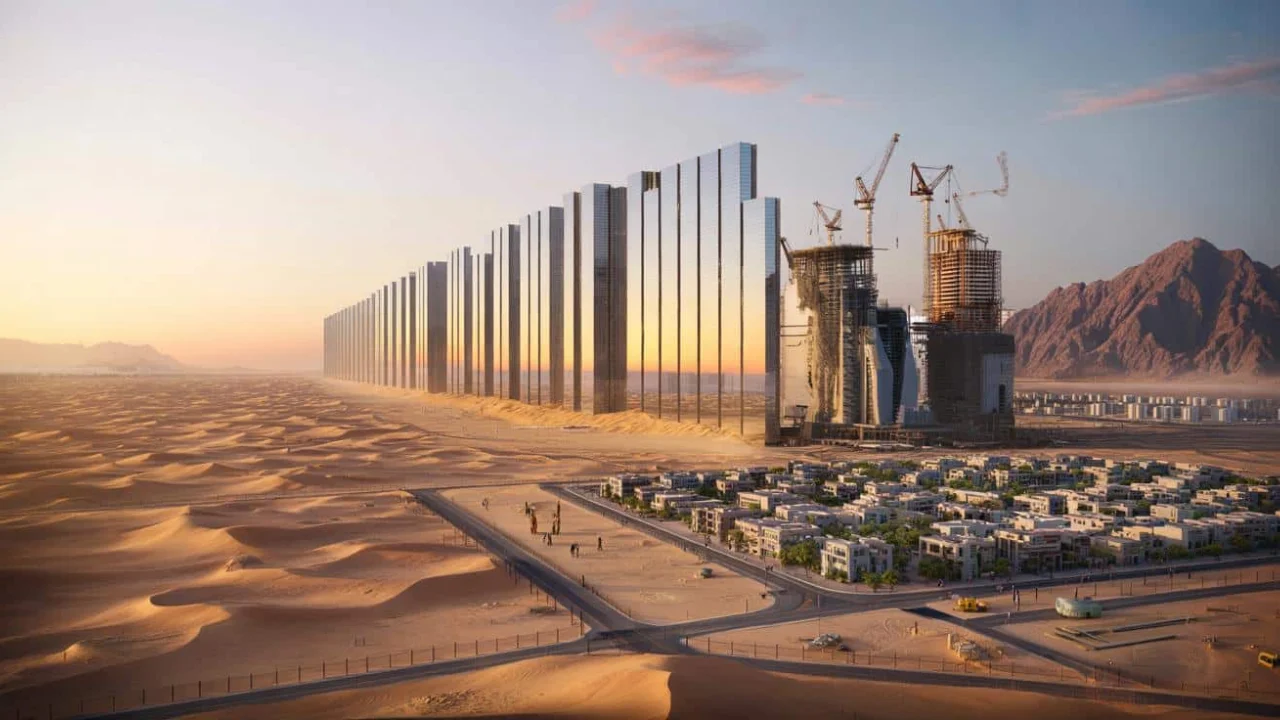
Saudi Desert Megacity: The idea of building a Saudi Desert Megacity in the middle of the vast Saudi landscape caught global attention when it was first revealed. Picture this: a futuristic city stretching for 100 miles in a perfect line, complete with mirrored walls, no cars, no pollution, and powered entirely by clean energy. That was the bold vision introduced under Saudi Arabia’s Vision 2030 initiative, with The Line at its center.
But things are shifting fast. Mounting costs and missed deadlines have led the Saudi government to reconsider. Now, the original Saudi Desert Megacity plan is being scaled back. In this blog, we will dive deep into what is changing, why the shift is happening, and what it means for the future of this ambitious project. Whether you are curious about smart cities, urban development, or global mega-projects, there is a lot to explore here.
Saudi Desert Megacity: What is changing and why it matters
The grand vision behind the Saudi Desert Megacity was not just about impressive architecture. It was about transforming the country’s economy, attracting foreign investment, and setting a new global standard for sustainability and innovation. But reality is catching up. With around 50 billion dollars already spent and more financial pressure building up, Saudi Arabia is now shifting its focus. Instead of a 100-mile continuous city, planners are now talking about smaller, phased zones that can be completed in stages.
The change in direction is not a total retreat. Officials are still committed to parts of Neom, especially where there is potential for revenue generation, like technology and AI infrastructure. The vision is now more grounded, with a strong focus on what can realistically be achieved in the next few years. This signals a major change not only for the kingdom but for other countries watching this project as a model for future urban development.

Project Overview: A Glance at the Saudi Desert Megacity
| Key Feature | Current Status |
| 100-mile linear city | Downsized to smaller segments |
| Estimated cost: $500 billion | Over $50 billion already spent |
| The Line centerpiece | Reconfigured or paused |
| Fully car-free design | Under reconsideration |
| Powered by renewable energy | Still planned in select areas |
| 9 million residents target | Scaled back estimates |
| Completion by 2030 | Phased rollout, extended timelines |
| Focus on tourism and luxury | Shift to AI and data centers |
| High-speed underground transit | Possibly delayed or reduced |
| Global investment attraction | Investor caution increasing |
Vision 2030 meets a reality check
Neom was launched with bold goals under Vision 2030: reduce oil dependence, increase tourism, and build futuristic cities. At the heart of that dream was The Line, two parallel skyscrapers stretching across the desert with zero emissions, vertical farming, and advanced tech. But behind the glossy promotional videos, cracks started to appear.
By late 2023, Saudi officials began to express concerns. The country was facing budget deficits, and spending had to be prioritized. One official described the pace as “rushing at 100 miles an hour.” With global oil prices dipping and investor enthusiasm slowing, the need to rethink became urgent. Saudi Arabia is now focusing on more financially feasible parts of the project, taking a step back from the original all-at-once approach.
‘We spent too much’: a costly vision trimmed down
The original cost projection for Neom was a staggering 500 billion dollars. By November 2023, close to 50 billion had already been spent, with some parts of the project falling way behind schedule. Sindalah, the luxury island resort, was one of the few components to open—but three years late and at three times the budget.
This kind of overspending has triggered a serious reassessment. The leadership is now taking a more measured approach. The plan is to scale back the city’s size, slow the pace of construction, and focus on areas that can start generating income sooner. That includes digital infrastructure, tech hubs, and less flashy but more functional urban zones. It is a big pivot from high-concept design to practical execution.

From utopian city to data and AI powerhouse?
The Saudi Desert Megacity is not being abandoned. Instead, it is evolving. The latest plans suggest a stronger focus on technology rather than tourism or luxury. Officials are eyeing the potential to turn Neom into a data and AI center for the Middle East. The wide desert land is perfect for building large-scale data centers, and Saudi Arabia’s renewable energy projects can help power them.
The region also offers strong global connectivity, thanks to subsea internet cables in the Red Sea. This makes it a promising location for cloud services and advanced computing. While it may not have the stunning mirrored walls once promised, this pivot could make Neom a key player in the global tech landscape.
Neom’s grand promises collide with delays
Marketing for Neom created high expectations. The Line was promoted as a city with no cars, 100 percent renewable energy, and unmatched innovation. Plans included ski resorts, floating ports, and futuristic neighborhoods. But in reality, only one part has launched—Sindalah—and even that came with delays and cost overruns.
These setbacks have not gone unnoticed. The former CEO of Neom was removed, partly due to frustrations around missed targets. As the original 2030 deadline now looks unrealistic, the government is revising its strategy. Future phases will be rolled out over time, likely well beyond 2030.

Oil prices, deficits and political risk
Saudi Arabia’s economic health is closely tied to oil prices. When prices drop, the ripple effect hits everything—including massive projects like Neom. Years of high public spending have stretched budgets, and now deficits are forcing a leaner approach.
Foreign investors, once excited about Neom, are now more cautious. Issues like regional security, lack of transparency, and project delays have created uncertainty. Without steady funding and global backing, megaprojects like this become harder to sustain.
What downsizing means for future megacities
The Neom experience is being closely watched by other countries with similar smart city ambitions. Whether it is Egypt’s new capital or India’s tech hubs, the lesson is clear: it is one thing to pitch a vision, and another to deliver it. Neom shows how political ambition, financial limits, and execution realities often collide.
Saudi Arabia’s decision to trim back the Saudi Desert Megacity could become a roadmap for others. It proves that while ideas like “15-minute cities” and car-free urban planning are exciting, scaling them needs caution, planning, and flexibility.

Risks and trade-offs that remain
Scaling back the Saudi Desert Megacity might save money, but it brings new challenges. One is reputation. Pulling back from headline promises could make it harder to build trust with international partners. Another is execution. Switching gears to AI and data infrastructure demands more than construction—it requires talent, legal clarity, and proper regulation.
There are also social concerns. Developing vast new areas can disrupt communities and local ecosystems. And then there is the question of how to make use of the tens of billions already spent. Turning sunk costs into something productive will be key.
FAQs
Is Neom still being built?
Yes, but the scale and focus are being revised. Instead of a 100-mile linear city, the plan now includes smaller zones with a focus on technology.
Why is Saudi Arabia scaling back Neom?
Mainly due to high costs, missed deadlines, and economic challenges like falling oil revenues and rising budget deficits.

What will happen to The Line?
Construction on the most ambitious parts of The Line has been paused. Planners are exploring smaller, more achievable sections.
Is the project being canceled entirely?
No, only scaled back. Neom is still moving forward with adjusted goals, focusing more on tech, AI, and realistic timelines.
Will the project still be completed by 2030?
It is unlikely. Timelines have been softened, and new phased plans may extend completion well beyond 2030.